
Reclaiming the Treaty’s vision of hope and reconciliation
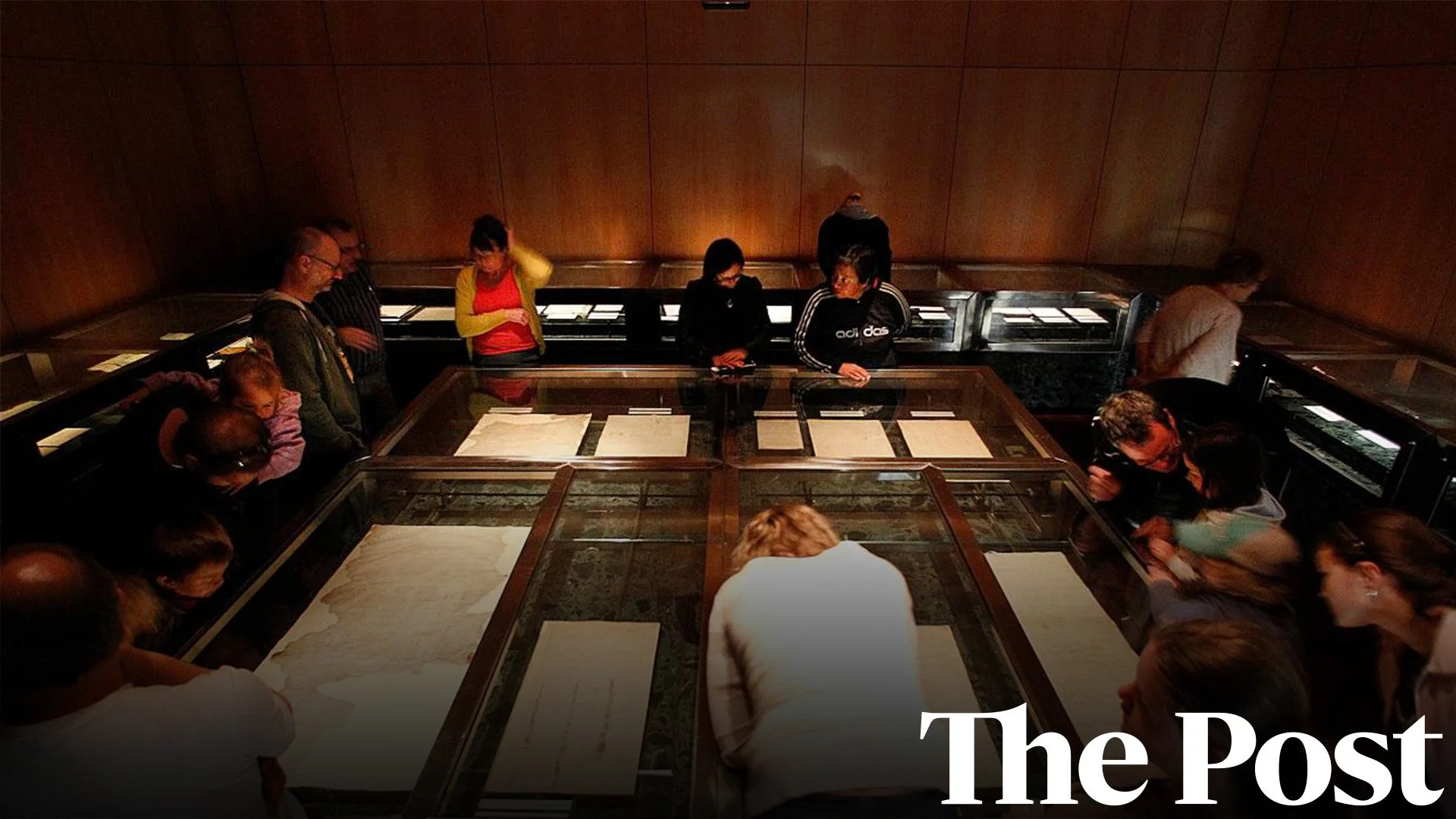
Visitors to the National Archives in Wellington inspect the original Treaty of Waitangi documents on display there. (File photo)CRAIG SIMCOX / DOMINION POST
Dr Alistair Reese is a historian, theologian and trustee of the Karuwhā Trust, which aims to engage New Zealanders in discussion about identity and history. He is the author of He Tatau Pounamu.
Opinion: In 1840, moments after signing his name to Te Tiriti o Waitangi, Ngāpuhi rangatira Ngāmanu prayed: “Haeremai e te tiriti o Waitangi! Haeremai ki tēnei ao. Haeremai me ngā hua kei roto ki a koe!” (“Welcome O Treaty of Waitangi! Welcome to this world. Welcome to the fruits that reside within you!”).
To Ngāmanu, this Treaty was an agreement of reconciliation and hope; as it was for the British Crown, who likewise regarded it as a reconciliatory mechanism and a reset in their dealings with indigenous peoples.
Church Missionary Society missionaries, too – including Henry Williams, their leader and an influential mediator of the Treaty – saw it as a covenant of peace in the midst of troubled times.
Not everyone saw it in this way, though. Edward Gibbon Wakefield of the New Zealand Company, perhaps reminiscent of some more modern complaints, viewed it as an impediment to his entrepreneurial colonisation plans. Chief Judge Prendergast concurred; in 1877, he notoriously labelled it a “simple nullity”.
Meanwhile the original parchment languished, water-damaged and rat-eaten, in the basement of Government House in Wellington.
Nearly a century later, a hopeful vision was reiterated when Governor-General Lord Bledisloe gifted the Waitangi Treaty site back to the nation. Borrowing a metaphor from te ao Māori at the dedication of the land in 1934, he declared: “Let Waitangi be to us all a tatau pounamu – a symbol of peace and unity.”
Before the large gathering he then prayed: “O God... grant that the sacred compact here made in these waters be faithfully and honourably kept for all time to come.”
Lord Bledisloe understood the Treaty was not only for Māori nor the Crown, but for everyone. This is succinctly implied by the cognomen coined by Sir Eddie Taihakurei Durie of “tangata tiriti” – a name given to all non-Māori who have a moral place of identity and belonging in the land through the gift of the Treaty.
It is time for us to recover this hopeful vision. The late Moana Jackson once likened the Treaty to “a mountain that will never move” (put another way, it’s not going anywhere – so let’s deal with it).
In recent times, a variety of voices have clashed over the Treaty. In many instances we have been guilty of talking past each other and not listening deeply.
While some stances have simply been cynical expressions of realpolitik, in many cases the questions raised deserve careful consideration. Our historical amnesia and cultural preferences have handicapped the Treaty debate; we need to know what it is before we know what it says.
Lord Bledisloe understood three immutable characteristics of the Treaty.
Firstly, that it provides a pathway of reconciliation that lays a constitutional foundation for building our nation.
Secondly, that it is tapu – a relational covenant, rather than a transactional legal contract. The late Rabbi Baron Jonathan Sacks described the difference in this way: “A contract is made for a limited period, for a specific purpose, between two or more parties, each seeking their own benefit. A covenant is made open-endedly by two or more parties who come together in a bond of loyalty and trust to achieve together what no one can achieve alone.”
In other words, “a contract is like a deal; a covenant is like a marriage... a covenant is about identity. And hence the vital distinction... a social contract creates a state; a social covenant creates a society.”
Lord Bledisloe enunciated a third important Treaty characteristic when he prayed that the Treaty be “faithfully and honourably kept for all time to come”. This is an inherent response to the oft-asked question “how long do we have to recognise this thing?” A covenant calls for an enduring commitment, even if that pledge proves to be inconvenient.
Nevertheless, the Treaty remains unsettled and many questions remain.
How do tino rangatiratanga [self-determination] and kawanatanga [governance] coexist? What are the ramifications of Article Three and Māori involvement in kawanatanga? What is the relationship of He Whakaputanga o Te Rangatiratanga o Nu Tireni (The New Zealand Declaration of Independence) to the Treaty of Waitangi? Can the English and te reo Māori versions of the treaty be reconciled?
These are just some of the questions that need careful and serious consideration in an environment of safety. Ad hoc legislative proposals are not the appropriate vehicle for an inquiry of such complexity and import.
What is needed are local Treaty forums that give an opportunity for catharsis and wisdom – perhaps in the form of a national wānanga, a Royal Commission, or a New Zealand version of South Africa’s Truth and Reconciliation Commission.
This would represent an adequately resourced gathering of this country’s Treaty experts that is conducted with an ethos of openness and mutual respect – the considerations to be shared strategically across the motu.
Either way, the people need to be heard, young and old, Māori and non-Māori. This process will take time. There can be no shortcuts.
The government has a duty of care to the wider population. That is genuine kawanatanga. The welfare of the nation is paramount. The vision of Waitangi – the source of our reconciliation and hope – needs to be nurtured and restored.
Haeremai e te Tiriti o Waitangi.