
How Mary and the Eucharist led Frank Ritchie to Catholicism | The Catholic Weekly
“I’m a Protestant minister who’s just prayed a Hail Mary. That’s awkward.”
For New Zealand broadcaster and former Wesleyan Methodist minister Frank Ritchie, that prayer helped restore a faith shaken by his daughter’s serious illness. Later, he experienced a sense of Christ’s presence in the Eucharist, which helped convince him that he belonged in the Catholic Church.
Ritchie entered the church during the 2026 Easter vigil. Speaking in a video interview with the Catholic Enquiry Centre in New Zealand in August, Ritchie said his conversion didn’t arise from dissatisfaction with the Wesleyan Methodist Church.
Rather, his conversion was “a sense of stepping into something that I just felt was true”.
Ordained in 2012, Ritchie founded a church in Hamilton in 2015 and also worked in radio broadcasting and as a chaplain to journalists. He loved his denomination for its seriousness about the Gospel and tradition of charitable work and social reform.
His interest in Catholic spirituality gradually developed over the years. An experience of being unable to pray in Bethlehem’s Church of the Nativity while visiting the Holy Land in 2012 drew him towards contemplative prayer and the Catholic mystics.
He began making retreats at a Cistercian monastery, where he joined the monks in the Liturgy of the Hours and memorised the Hail Mary so he could pray it out of respect for them.
“I’d cross my fingers, thinking nothing’s going to happen; it’s not evil, but it’s just useless,” he said.
He also read Pope Benedict XVI’s Jesus of Nazareth trilogy and was struck by the pope’s Christ-centred writing. His daughter’s health deteriorated in late 2023 and the family needed to raise $200,000 for life-saving surgery in Germany.
Angry and unable to pray, Ritchie gave God an ultimatum: heal his daughter within 48 hours or he would walk away from his faith. The deadline passed, leaving him feeling empty.
While in Germany, he sought refuge in churches in Frankfurt, Leipzig and Düsseldorf. Unable to pray or read Scripture, he simply sat among their stained-glass windows, statues and sacred art.
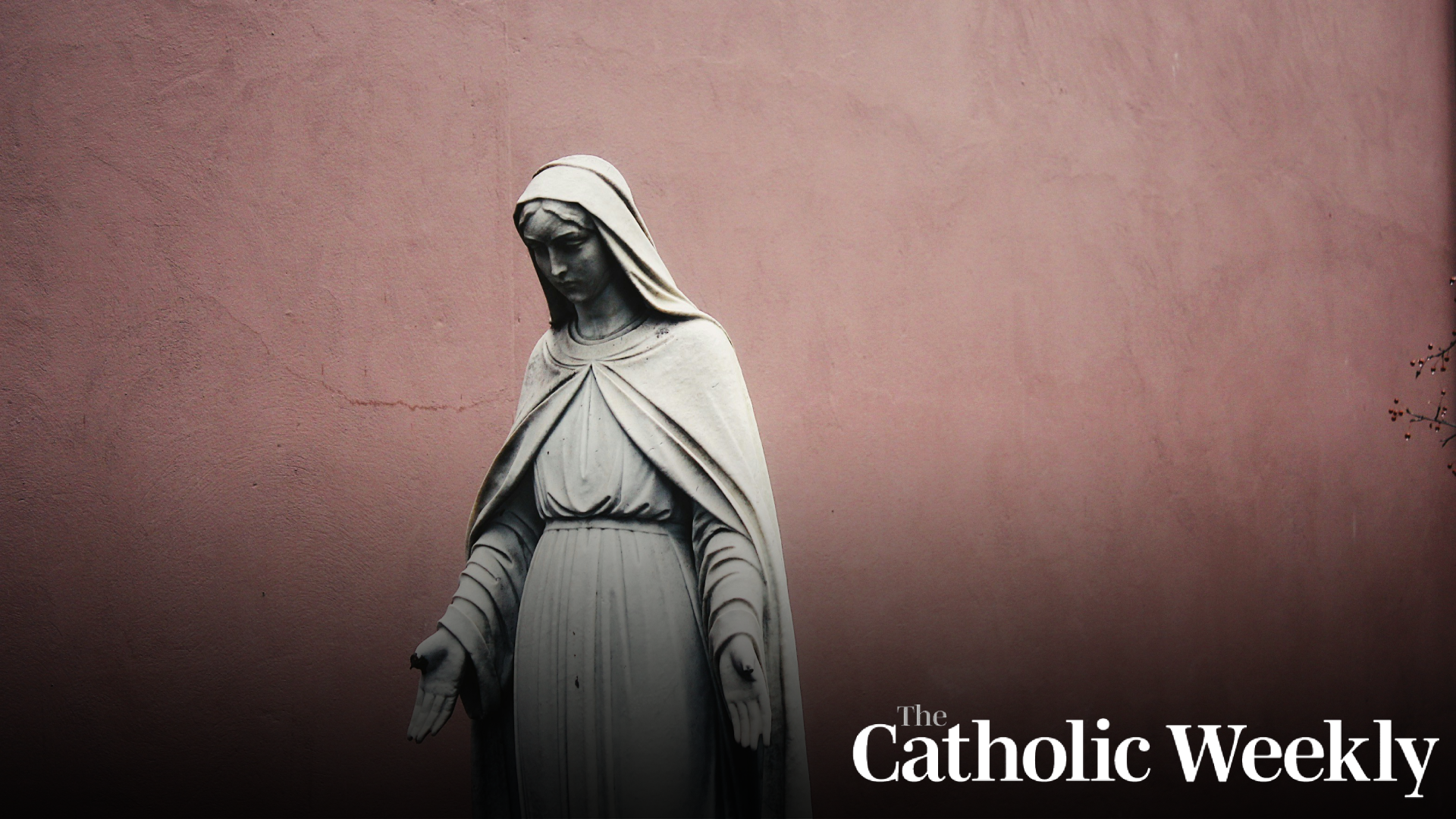
The images of Mary caught his attention. After returning home, still struggling to pray, he remembered them.
“She feels approachable and it can’t hurt to ask her for help,” he thought.
This time, he prayed the Hail Mary sincerely and sensed a presence that was “gentle”, “warm” and “comforting” and, for reasons he could not explain, feminine. A week later, he was able to turn back to Jesus, open his Bible and pray again.
“In good Mariology, she’s just done what any good Catholic thinks is her job – pointed the way back to her son,” he said.
“Mary saved my faith.”
That experience opened the way for an emotional and spiritual encounter with Catholicism to accompany Ritchie’s intellectual search.
He wrestled with papal authority, apostolic succession, the communion of saints and transubstantiation. The authority of the Bishop of Rome was especially important: if the pope and the magisterium possessed genuine authority, Ritchie believed conscience required him to respond.
His understanding of the Eucharist changed during a Mass when, as the priest prayed over the gifts, a thought struck him: “He’s in the room.”
“If this really is our saviour, just sitting in the room with him is enough,” he said.
“There’s nothing that I have to do. It’s not based on my faith. He’s not turning up because I’ve got any sense of faith. I don’t have to feel anything. This is just not on me. And he’s here.”
Becoming Catholic nevertheless carried a considerable personal cost. Ritchie’s wife remained deeply Wesleyan, while his denomination had supported his family through their hardest years.
He feared disappointing friends, losing valued relationships and being seen as disloyal. But a conversation with Fr Justin Lee of the Brothers of St John helped bring his discernment into focus. The priest told him not to enter the church until he had encountered its holiness.
Ritchie recognised that holiness during a packed Mass for the Feast of the Holy Family. Sitting at the back of the cathedral, he watched families and children gather around the Nativity scene after Mass, smiling, taking photographs and touching the figures of Jesus, Mary and Joseph.
“I felt like I had just encountered holiness,” he said.
“I’d gone from asking the church to prove itself to me, to asking it to teach me.”
His wife accompanied him throughout the church’s initiation program, although she did not herself seek to become Catholic. Ritchie now attends an early Mass before joining her for worship with their Wesleyan community.
Catholicism still feels culturally unfamiliar at times, he says, adding that it is important for parishioners to welcome people who are new to the church.
What most attracts him is its embodied character: kneeling, incense, sacred art, confession, the communion of saints and, above all, the Eucharist. Borrowing an image from CS Lewis, Ritchie compared Protestantism to a desert and Catholicism to a jungle crowded with traditions and devotions.
“I’ve got to the space where I want the jungle,” he said.
“I want all the bells, the whistles, the incense, the long readings, the standing, the sitting, the kneeling. I want all of that because all of that is a gift.”
Read the full piece, and watch the full interview on the Catholic Enquiry Centre.
