
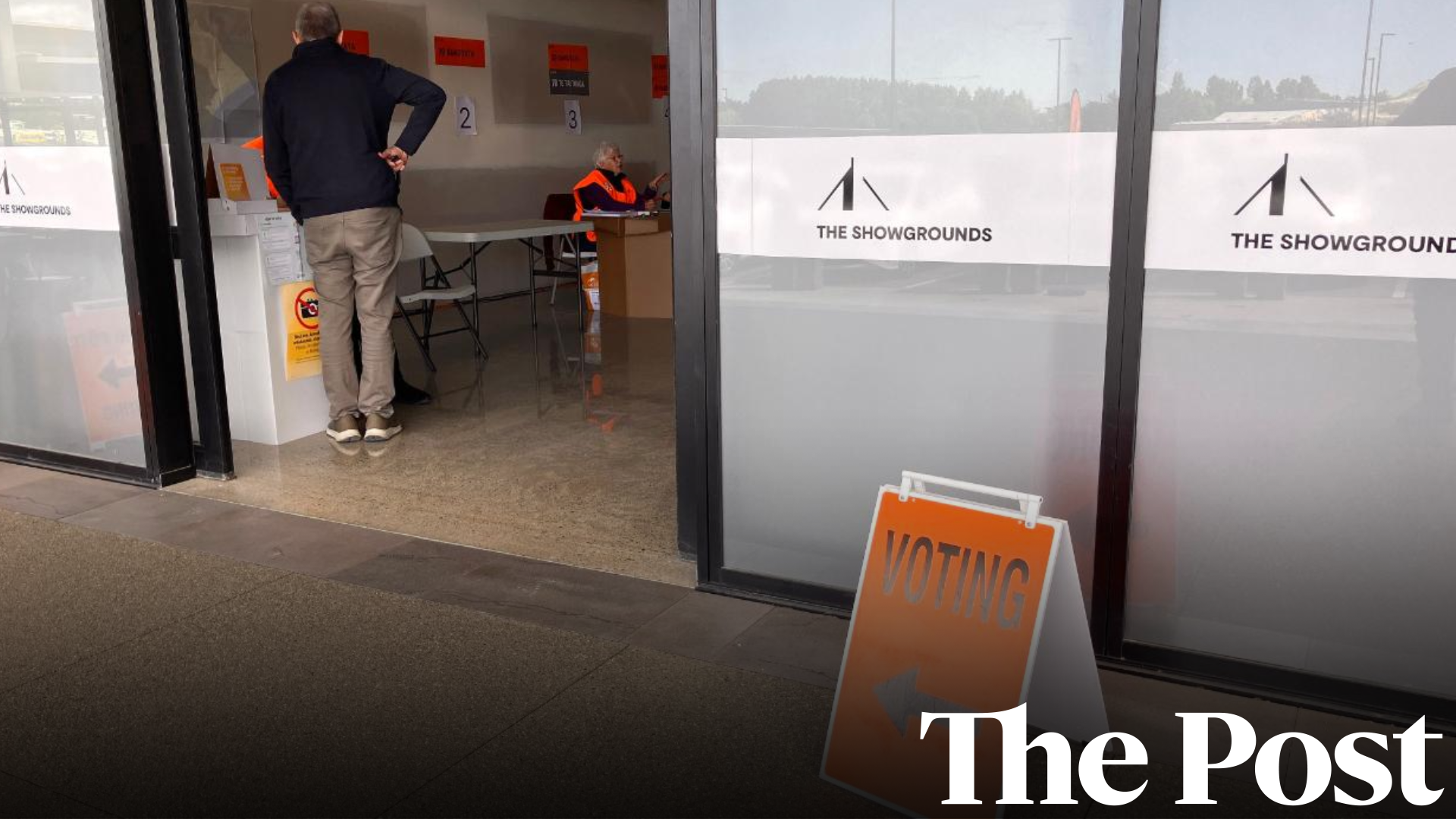
Who are you voting for? And does anyone really care any more? Photo: DOUG SAIL
Scottie Reeve is an Anglican priest and author from Brooklyn, Wellington.
OPINION: “Who are you voting for?”
Even in the final days before election day, it’s a question many of us struggle to find an answer to.
The majority of voters across Western democracies have lost faith in the people in power to make good decisions for our future. And so, when asked the question, “who are you voting for?” many of us think, simply, “who cares?!”.
A Pew Research study in 2023 said 65% of Americans felt “exhausted” when thinking about politics. The National Centre for Social Research found that 45% of the British constituency did not trust governments to put national interests ahead of partisanship. And here in Aotearoa, a study by the Helen Clark Foundation reported that only 39% of New Zealanders trust our government.
When you look at the nature of our political discourse, it’s not surprising.
I recently took my 6-year-old on a parliament tour. The House wasn’t sitting that day, so there were no debates to watch. But rather than disappointment, I felt relief. I didn’t have to worry about her hearing or seeing our political leaders behave worse than anything she might hear during lunchtime at school.
This kind of discouragement, writ large, has created an environment where many of us have lost belief in the credibility and capability of our institutions.
And for many, that’s just the start. We are starting to wonder, “is change possible at all?” If we are powerless to do anything about climate change, wealth inequality, child poverty and homelessness, what does this mean for our lives and our future?
The police operation to clear Parliament of an occupation camp protesting against the Covid vaccine mandates in 2022, perhaps the low point of cynicism towards our political leaders.
If we’re not careful, our imagination can start to dull. The fires of childhood become a smoulder. The slow but seductive pull of the status quo erodes our hope until we settle for little more than existence. Maybe we download a few apps in the hope of self-improvement, because social change is just too audacious.
It reminds me of the words of the American theologian Rachel Held-Evans, who says this: “Cynicism is a powerful anaesthetic we use to numb ourselves to pain, but which also, by its nature, numbs us to truth and joy.”
And I get it. When disappointment is the mood, it can feel naive to hope.
But I wonder, what if we’ve got our response to this profound moment of disillusionment all wrong?
What if this is the very moment imagination is made for?
I’m inspired by the response of many Māori leaders over the past four years.
The 2024 hikoi to Parliament protesting against government measures seen as anti-Māori.
Consider the consistent assault on their culture by successive governments, both left and right, but the unmatched resolve to continue to gather together for wānanga, speak te reo, and stand for their rights.
What allows an oppressed people to get hit again and again, and yet continue to rise?
Maybe, it’s because they have a bigger story that preserves their collective imagination. Their fight isn’t about mere individuals, it’s about mokopuna. It’s not about a moment, it’s about whakapapa. It’s not about houses, properties, or deeds - it’s about te taiao and te Tiriti.
The tantrums of some of our representatives might last a social media cycle, but they can’t outlast an intergenerational imagination for change. Mountains have never bowed to members' bills.
As a Pākehā New Zealander, I’m jealous of this kind of imagination.
As an Anglican Priest, I’m inspired to dig into my own whakapapa.
The psalms, a book of ancient songs, is full of moments of despair where the lyricist can’t move forward. He looks at the desolation of his life and the world around him, and asks, “God, have you left us for dead?” Fearing literal enemies at the gates, he pours out his distress and descends into the darkest corners of his soul.
But then, many times, there’s a turning point.
He lifts his eyes. He looks to the mountains, the skies and the stars. There he is reminded that he is held in bigger hands, and his imagination is revived to fight another day.
It’s an idea put beautifully by another psalmist closer to home, Jon Toogood of Shihad.
Do you know what the time is?
Is it messing with your mind, kid?
Are you hurting all the time
And you need a pacifier?
Come on, let's take a look outside.
The temptation of this moment is to shirk and shrink; to stop looking at the stars and start crawling into the recesses of our own minds. But the deeper we get into ourselves, the harder it is to feel that participating in something national or global actually matters.
I think it’s time for the people of the long white cloud to lift our eyes. This isn’t the time for diminished hope; it is the precise moment for an enlarged imagination.
Friends, do not let your spirit wane. Go outside, put your feet in the soil. Lift your eyes to the stars. Think about your kids, your parents, think about eternity. Take a deep breath and - naively, precociously, audaciously - vote for the world you dream of. Then, regardless of the outcome on Election Day, find the strength and perspective to make it a reality.
It’s a big world out there, and it needs big imaginations to make it beautiful.
