
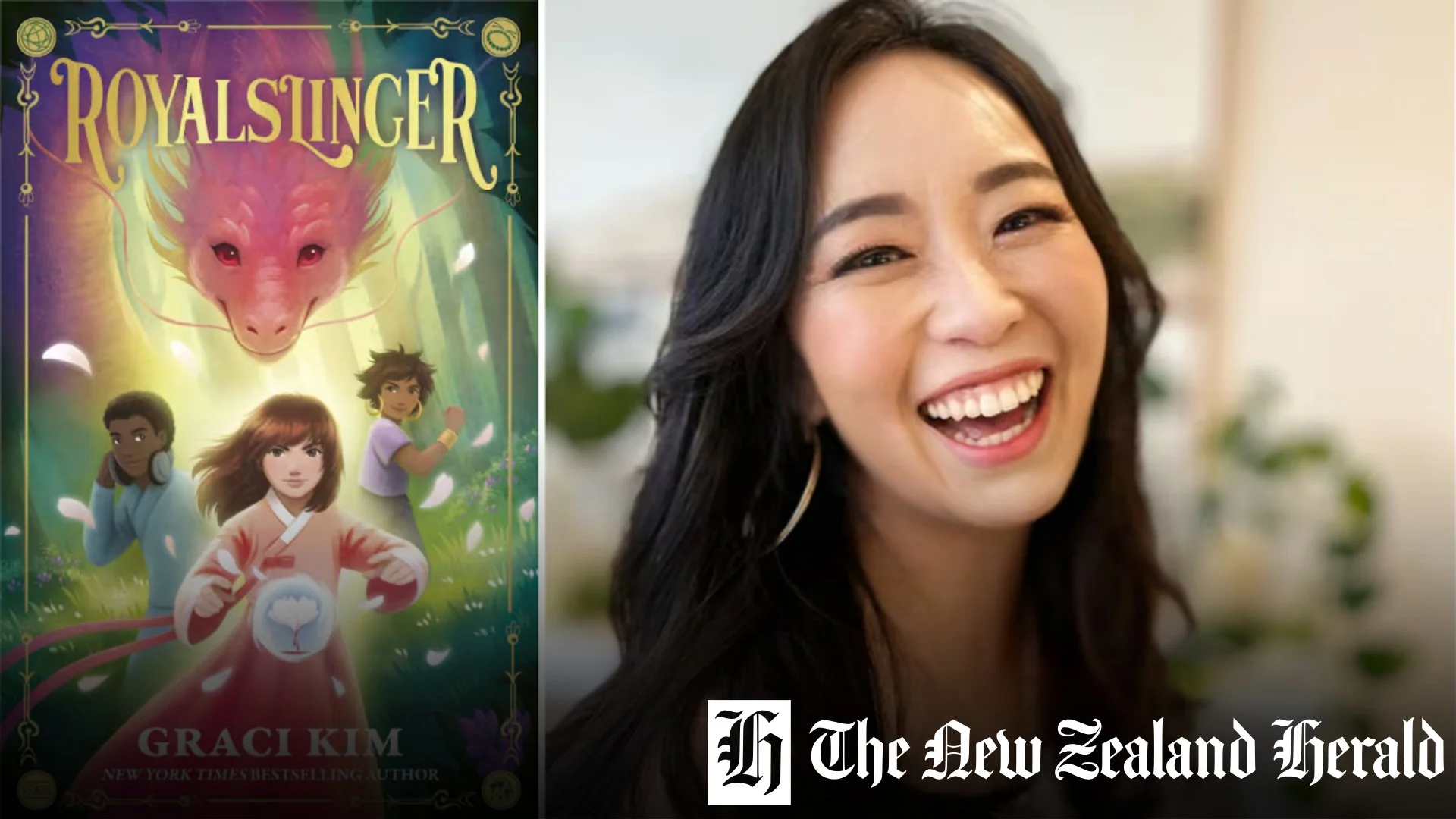
New York Times bestselling children’s book author Graci Kim. Photo / Ally Oughton
Graci Kim is the New York Times bestselling author of the Gifted Clans trilogy and the Slinger children’s book series, and has appeared in TIME for Kids.
Writing was not her first career, and she spoke to Real Life with John Cowan on Newstalk ZB on Sunday night about key experiences that led her there.
Kim moved to Auckland from Korea when she was 3. Despite having a “beautiful childhood”, she also experienced racism as an immigrant.
“When grown-ups are in front of us throwing eggs at my father, or saying really terrible things to my mum – you sit back and think, what does that say about my place in this world?”
She recalled people telling her to “go back to her own country”, and being bullied at school.
Those experiences significantly shaped the way she viewed herself. She also keenly felt a lack of representation in media.
In primary school, when asked to do a creative writing assignment, she described her family as blonde-haired and blue-eyed. A teacher questioned her choice of words afterwards.
“I remember being very confused … it wasn’t that I didn’t know my family were Korean, it’s just that I’d never read about characters who looked like me.
“I’d just made this rule in my head that, regardless of what you actually look like, in books you have to look a certain way.”
Despite the hardships their family faced, she always admired her parents’ resolve in facing them with a “stoic grace”.
Cowan was curious at the mention of stoicism, and asked whether any philosophies or religious heritage played a part in their resilience.
She grew up with two religions in her family, with her father’s side Christian and her mother’s Buddhist.
Despite not identifying with either, she feels her upbringing created an interesting outlook on life, where “nothing was off the table”. As a parent, she now openly discusses spirituality with her daughter.
She drew on an ancient Indian parable, the blind men and the elephant, to explain how she views religion today.
“[The blind men] touch different parts [of the elephant] and describe it completely differently, because the trunk is different to the tail, is different to the ear, is different to the leg – but together, perhaps we’re all speaking truth; we just can’t see the bigger elephant.”
Before writing books for a living, she was a Ministry of Foreign Affairs and Trade diplomat. She believes her experiences growing up played a part in choosing that career.
“I wanted to show that I had value to this country, that I was worthy of being accepted – and by representing my country on the international stage, maybe other people could see that too.”
There were formative experiences during her career that would help point her toward writing.
It was while she was on a diplomatic posting in Taipei that she was brushed by death.
She was dropping off a birthday cake for a friend when a concrete truck “came out of nowhere” and nearly collided with her while walking through a pedestrian crossing.
Kim came out of the experience alive, but others were not so fortunate.
“The two people right behind me – a mother and her 12-year-old child – got hit. It was horrific – the daughter died on impact, and the mother was on the ground, crying out for help.”
Kim went over to the woman and held her hand until she died.
She told Cowan she felt guilty because she somehow believed that it was supposed to be her.
The conclusion she came to was that life needs to be lived fully, since no one knows when their time is up.
A short time later, she had a medical emergency on another diplomatic posting in Beijing.
“I went into work, and I couldn’t see my screen. It was the bizarrest thing. When I went to get my eyes checked, I got medevaced straight to an eye hospital, and the ophthalmologist basically said, ‘Graci, if you don’t get emergency eye surgery in the next 24 to 72 hours, you’ll be blind’.”
“It was pretty wild – I went from living a really busy life to everything stopping, and I think it was that moment of pause that made me reflect on these things.”
During this time, she was unable to do much and began telling herself stories and folklore from her childhood. She then wondered why books weren’t created with these in mind.
She recalled her experience in primary school and the lack of characters like her in books.
“If you don’t see yourself reflected on the page or the screen, it tells you that you’re not worthy, that you don’t belong, your voice has no weight, and you don’t deserve to take up space.”
She describes writing her first series as “self-therapy”. Her debut book, The Last Fallen Star, was published in 2021, and became the first of a trilogy. It is aimed at readers aged 8-12, with a narrative inspired by Korean mythology.
It went on to be a 2021 Goodreads Choice Award Nominee for Best Children’s Book, an Amazon Best Book, a Barnes & Noble Young Reader Pick, and included in the Whitcoulls Kids’ Top 50.
One of her favourite parts of the job, aside from writing, is speaking to school students about creativity, resilience and “the power of failing”.
“I love sharing that with young people whose minds are still malleable, and who have dreams and aspirations for their lives.”
In her writing, she now aims to fill the gap she felt as a child.
“It was something I really wanted to do for kids like me – to see themselves reflected on the page, and know that they too can be the heroes of the books, and in turn, of their own lives.”
